Conversion-Focused Website Optimization
Conversion-Focused Website Optimization
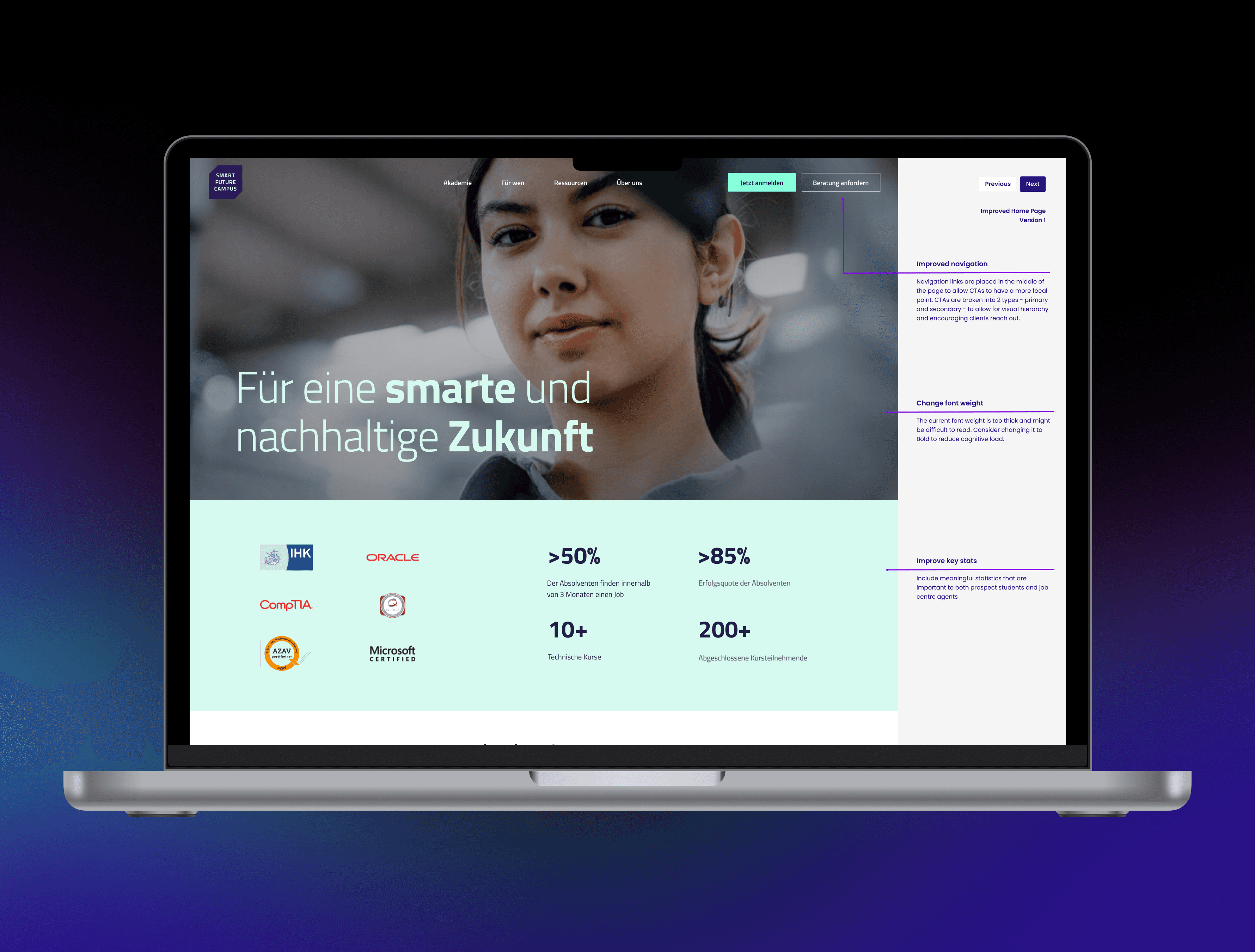
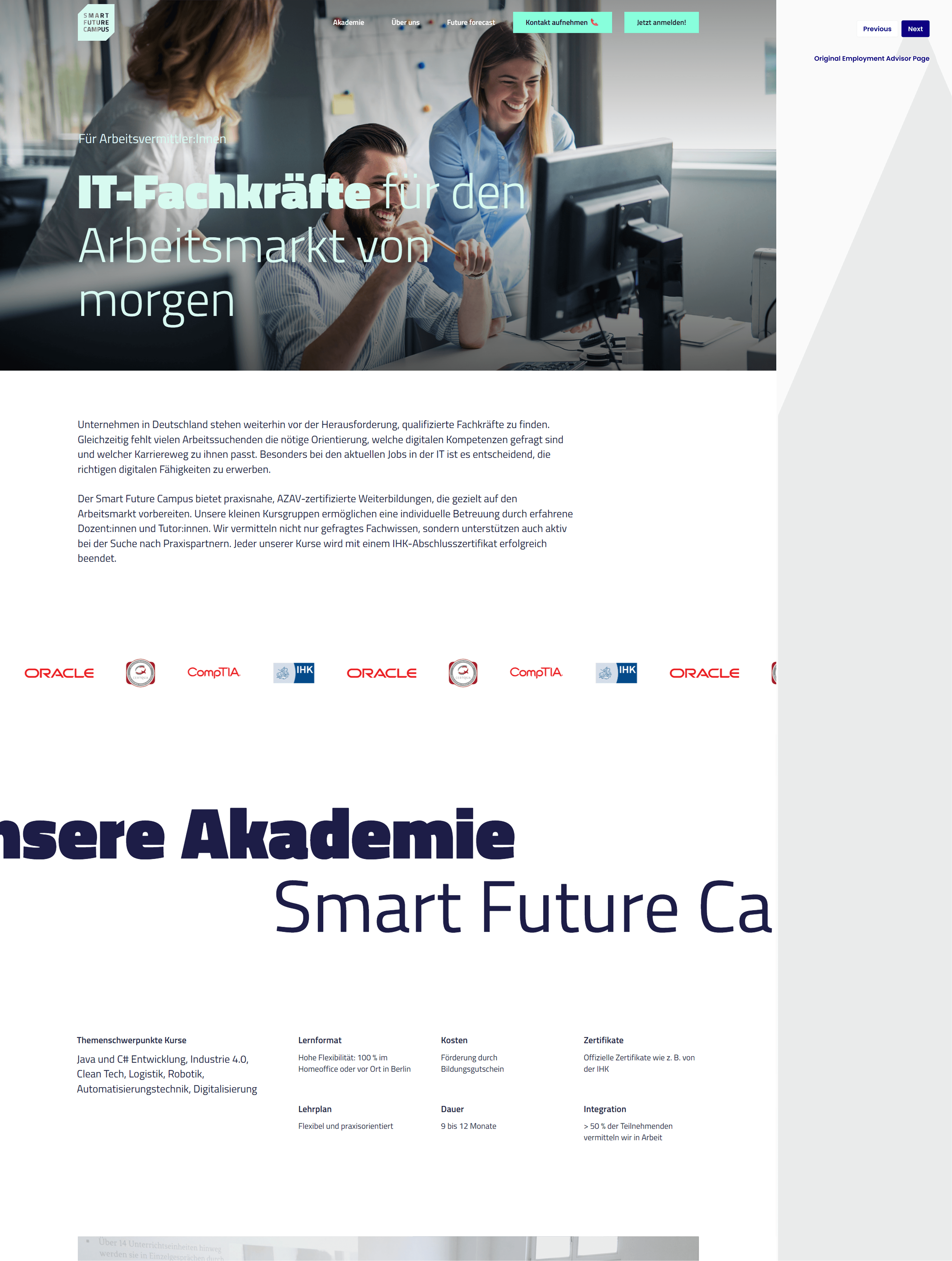
Led a freelance UX consulting project to increase Smart Future Campus’s website conversion rate by 5% through research-driven, low-effort UX improvements. Delivered a strategic redesign proposal focused on conversion, credibility, and mobile usability — optimized for limited developer capacity.
Problem
Despite 1,000+ monthly visitors, the website converted only 1.1% of users into consultation requests.
Through extensive research, I found the following key issues:
75% mobile traffic with significant UX friction
Poor course discoverability despite high intent
Dead-end pages (FAQ and Academy had 0% direct conversion)
Weak trust signals in a credibility-sensitive market
No clear structure for job seekers vs. job center agents
Limited analytics and funnel tracking
Constraint: No capacity for a full rebuild — improvements had to be high-impact and low-effort for developers.
Problem
Despite 1,000+ monthly visitors, the website converted only 1.1% of users into consultation requests.
Through extensive research, I found the following key issues:
75% mobile traffic with significant UX friction
Poor course discoverability despite high intent
Dead-end pages (FAQ and Academy had 0% direct conversion)
Weak trust signals in a credibility-sensitive market
No clear structure for job seekers vs. job center agents
Limited analytics and funnel tracking
Constraint: No capacity for a full rebuild — improvements had to be high-impact and low-effort for developers.
Goal
Increase consultation conversions by 5% through structural and UX improvements without a full redesign.
Secondary goals:
Reduce funnel friction
Improve trust perception
Surface course information within 1–2 clicks
Support multiple personas with clearer pathways
Goal
Increase consultation conversions by 5% through structural and UX improvements without a full redesign.
Secondary goals:
Reduce funnel friction
Improve trust perception
Surface course information within 1–2 clicks
Support multiple personas with clearer pathways
Goal
Increase consultation conversions by 5% through structural and UX improvements without a full redesign.
Secondary goals:
Reduce funnel friction
Improve trust perception
Surface course information within 1–2 clicks
Support multiple personas with clearer pathways
My Role and Approach
Freelance UX Consultant leading research, strategy, and redesign proposal.
Discovery & Research:
Analyzed 90 days of GA data (12,770 users)
Reviewed Hotjar user session recordings
Identified conversion drop-offs and navigation friction
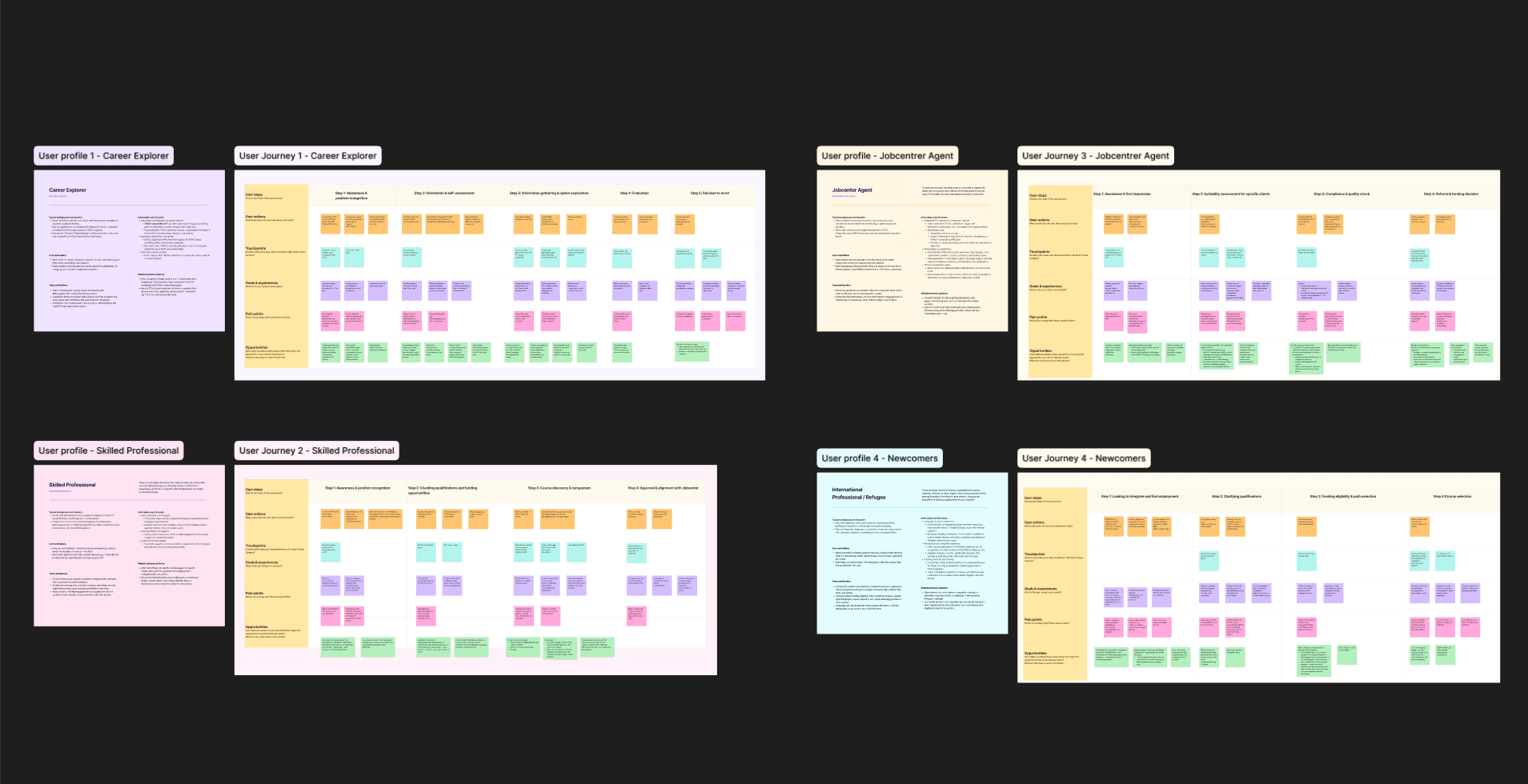
Defined 4 primary personas and created journey maps for each
Conducted competitive benchmarking (IBB, WBS, IU, neue fische)
Focused on identifying high-leverage improvements that aligned with existing technical constraints.
My Role and Approach
Freelance UX Consultant leading research, strategy, and redesign proposal.
Discovery & Research:
Analyzed 90 days of GA data (12,770 users)
Reviewed Hotjar user session recordings
Identified conversion drop-offs and navigation friction
Defined 4 primary personas and created journey maps for each
Conducted competitive benchmarking (IBB, WBS, IU, neue fische)
Focused on identifying high-leverage improvements that aligned with existing technical constraints.
My Role and Approach
Freelance UX Consultant leading research, strategy, and redesign proposal.
Discovery & Research:
Analyzed 90 days of GA data (12,770 users)
Reviewed Hotjar user session recordings
Identified conversion drop-offs and navigation friction
Defined 4 primary personas and created journey maps for each
Conducted competitive benchmarking (IBB, WBS, IU, neue fische)
Focused on identifying high-leverage improvements that aligned with existing technical constraints.
Key Solutions
Clear Conversion Hierarchy
Prioritized one primary CTA (consultation request) and reduced competing actions.
Simplified Information Architecture
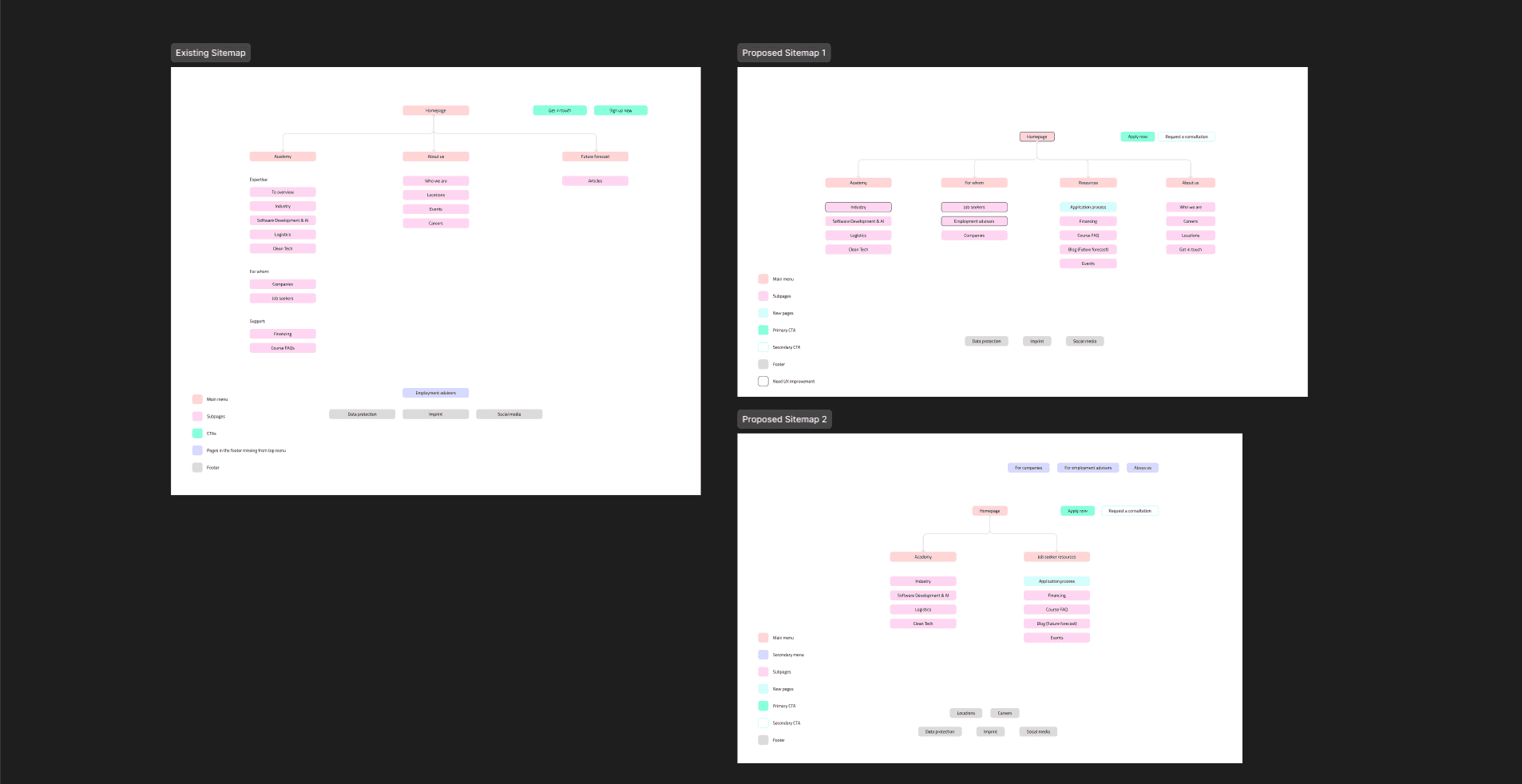
Made course content accessible within 1–2 clicks and removed low-converting pages.
Audience-Based Structuring
Created clearer pathways for job seekers and job center agents.
Mobile Optimization
Addressed major friction points affecting the 75% mobile audience.
Key Solutions
Clear Conversion Hierarchy
Prioritized one primary CTA (consultation request) and reduced competing actions.
Simplified Information Architecture
Made course content accessible within 1–2 clicks and removed low-converting pages.
Audience-Based Structuring
Created clearer pathways for job seekers and job center agents.
Mobile Optimization
Addressed major friction points affecting the 75% mobile audience.
Outcome
Implementation is in progress, so quantitative results are pending.
However:
The client approved the strategy and confirmed it addressed their core business challenges.
A clear measurement and post-launch testing plan was delivered to track progress toward the 5% conversion goal.
The project demonstrated the ability to drive strategic UX improvements within tight development constraints.
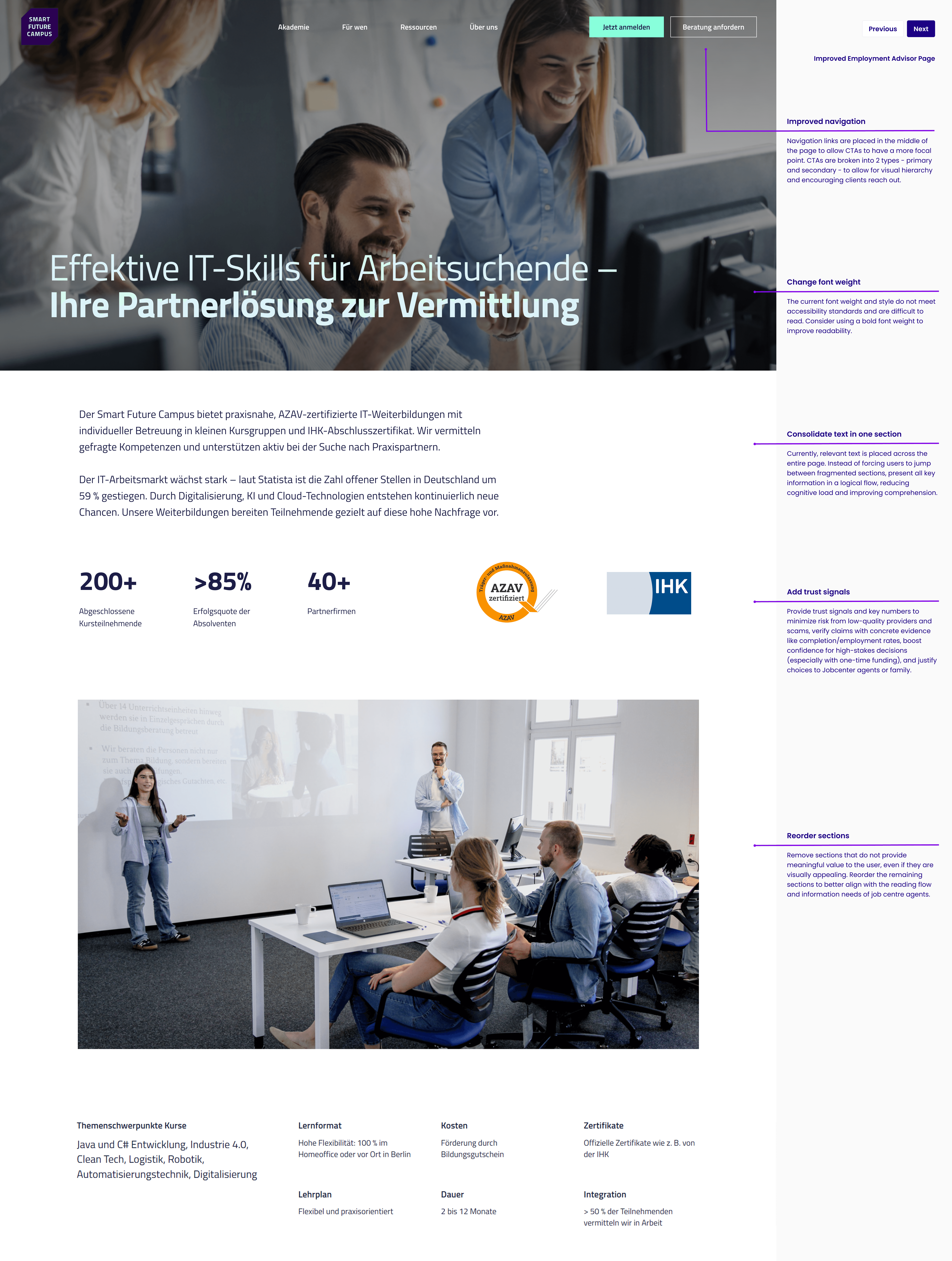
View client demo here.
Outcome
Implementation is in progress, so quantitative results are pending.
However:
The client approved the strategy and confirmed it addressed their core business challenges.
A clear measurement and post-launch testing plan was delivered to track progress toward the 5% conversion goal.
The project demonstrated the ability to drive strategic UX improvements within tight development constraints.
View client demo here.
More Work More Work
©2026 Maria Gogoleva
GO BACK TO TOP
©2026 Maria Gogoleva
GO BACK TO TOP
Conversion-Focused Website Optimization
Led a freelance UX consulting project to increase Smart Future Campus’s website conversion rate by 5% through research-driven, low-effort UX improvements. Delivered a strategic redesign proposal focused on conversion, credibility, and mobile usability — optimized for limited developer capacity.
Problem
Despite 1,000+ monthly visitors, the website converted only 1.1% of users into consultation requests.
Through extensive research, I found the following key issues:
75% mobile traffic with significant UX friction
Poor course discoverability despite high intent
Dead-end pages (FAQ and Academy had 0% direct conversion)
Weak trust signals in a credibility-sensitive market
No clear structure for job seekers vs. job center agents
Limited analytics and funnel tracking
Constraint: No capacity for a full rebuild — improvements had to be high-impact and low-effort for developers.
Goal
Increase consultation conversions by 5% through structural and UX improvements without a full redesign.
Secondary goals:
Reduce funnel friction
Improve trust perception
Surface course information within 1–2 clicks
Support multiple personas with clearer pathways
My Role and Approach
Freelance UX Consultant leading research, strategy, and redesign proposal.
Discovery & Research:
Analyzed 90 days of GA data (12,770 users)
Reviewed Hotjar user session recordings
Identified conversion drop-offs and navigation friction
Defined 4 primary personas and created journey maps for each
Conducted competitive benchmarking (IBB, WBS, IU, neue fische)
Focused on identifying high-leverage improvements that aligned with existing technical constraints.
Key Solutions
Clear Conversion Hierarchy
Prioritized one primary CTA (consultation request) and reduced competing actions.
Simplified Information Architecture
Made course content accessible within 1–2 clicks and removed low-converting pages.
Audience-Based Structuring
Created clearer pathways for job seekers and job center agents.
Mobile Optimization
Addressed major friction points affecting the 75% mobile audience.
Outcome
Implementation is in progress, so quantitative results are pending.
However:
The client approved the strategy and confirmed it addressed their core business challenges.
A clear measurement and post-launch testing plan was delivered to track progress toward the 5% conversion goal.
The project demonstrated the ability to drive strategic UX improvements within tight development constraints.
View client demo here.
More Work More Work
©2026 Maria Gogoleva
GO BACK TO TOP